

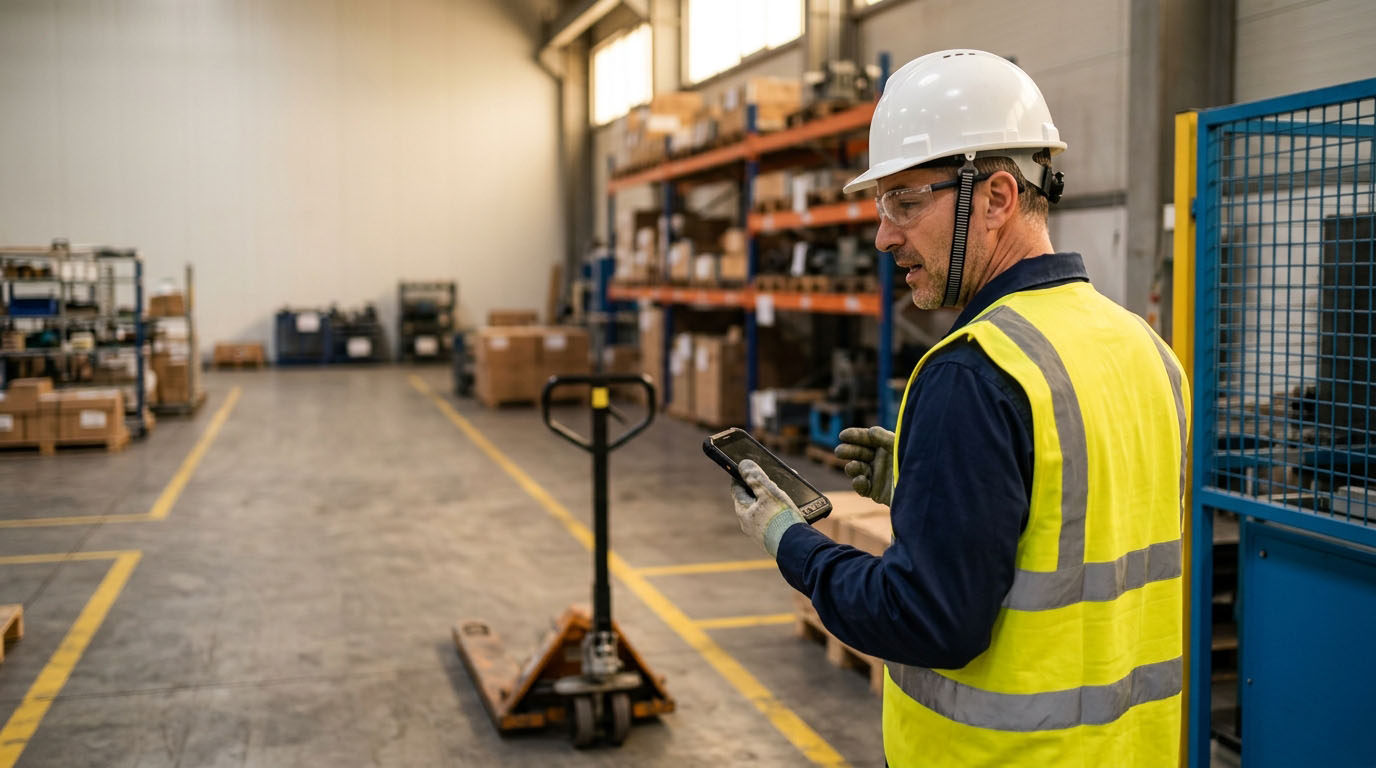
A safety observation records something seen at work that affects safety: a physical condition, an action somebody took, or good practice worth repeating. Sites collect them on cards, in an app, or through a word with a supervisor.
Examples of all three follow. The harder question, which the examples do not answer on their own, is what makes any of them worth reading a month later.
What is a safety observation?
A safety observation is a record of a workplace condition, behaviour or practice that affects safety, made by somebody who saw it. Nothing has to have gone wrong, which is what separates it from an incident report. Its purpose is to surface risk while it is still cheap to fix, and to name good practice when it happens.
Safety observation examples: unsafe conditions
Conditions are the easiest to see and the easiest to write down, which is why they dominate most programmes.
| What you see | What to record beyond the category |
|---|---|
| Pallet jack parked across a walkway near a fire exit | Which exit, how far, and whether it happens on a particular shift |
| Standing water or oil at the base of a press | Where it comes from and whether the leak has been reported before |
| Extension lead run across a traffic route | Why the permanent supply is not being used |
| Guard removed or bypassed on a machine | Which guard, and whether removal is needed to run the job |
| Racking damaged at floor level | Which bay, and whether the load above it has been checked |
| Ladder tied at one point instead of two | Whether the right ladder was available on site |
| Chemical decanted into an unlabelled container | What is in it and who decanted it |
| Emergency stop obstructed by stored material | How long the material has been there |
| Gas cylinders stored unsecured or with fuel and oxidiser together | Whether the store is full |
| Lighting failed over a walkway or stair | How long it has been out and whether it has been raised |
Safety observation examples: unsafe acts
Behaviours are harder to write about, because the observer has to describe a colleague. Programmes that punish the person named see this category collapse inside a quarter.
| What you see | What to record beyond the category |
|---|---|
| Hearing protection not worn near running plant | Whether the dispenser nearby was stocked |
| Working at height without the harness clipped | Whether there was an anchor point within reach |
| Lifting alone something rated for two people | Whether the lifting aid was available and charged |
| Reaching into a machine without isolating it | How long the isolation would have taken |
| Mobile plant reversing without a spotter | Whether the route allows a forward exit |
| Standing under a suspended load | Whether the exclusion zone was marked |
| Removing gloves to do a fiddly task | Whether a glove suited to the task exists on site |
| Skipping the pre-start check on a vehicle | Whether the check takes longer than the handover allows |
| Using a phone while operating plant | What the call was about, which is usually work |
| Starting before the permit is signed | Whether the signatory was reachable |
Safety observation examples: safe practice worth naming
Most programmes ignore this category. It is the one that changes behaviour fastest, because it tells a crew what right looks like in their own setting rather than in a poster.
| What you see | What to record beyond the category |
|---|---|
| A crew stopping a job when a reading came back wrong | What they did instead, and who backed the decision |
| Somebody clearing a spill they did not create | Whether the materials to clear it were to hand |
| A standby man rigging retrieval before an entry | Whether this is normal here or unusual |
| A supervisor changing a plan after a worker raised a concern | What the worker said and what changed |
| A contractor asking where something is stored rather than guessing | Whether the induction covered it |
| A team using a mechanical aid nobody has used in months | Where it was and why it went unused |
What makes a good safety observation?
A good observation lets somebody who was not there understand what was seen and why it mattered. Four things do that work: where it was, how often it happens, what caused it to be that way, and what the observer did.
The same event, written twice:
| Weak | Useful |
|---|---|
| “Housekeeping issue in Aisle 4. Corrected.” | “Pallet jack parked across the walkway two metres from the east fire exit. Third time this week, all on nights. Nothing has been marked as a parking spot since the racking moved in July. Moved it and told the shift lead.” |
| “Operator not wearing PPE. Reminded him.” | “Operator running the number two compressor without earplugs. Says the dispenser by the door has been empty since last week and the store is on the far side of the plant. Gave him a pair from my kit.” |
| “Good job by the team today.” | “Crew on the tank entry stopped when the monitor alarmed on the second reading, rather than re-testing for a pass. Standby man had the retrieval line rigged before anyone went in. Worth naming at Monday’s brief.” |
The left column can be counted. The right column can be fixed, and it names a cause the site can do something about: unmarked parking after a racking change, an empty dispenser a long walk from the work.
Read your own last hundred cards against that test. Most operators find the split uncomfortable.
Why do observation programmes drift toward PPE and housekeeping?
Because those two categories are the cheapest to see and the safest to report about a colleague.
Set a quota of two observations per person per shift and you will get two per person per shift. The quota cannot specify quality, so it gets satisfied by whatever costs the observer least. Hard hats and trailing cables cost least. A conversation about why a crew skipped an isolation costs a great deal more, and it is the one that would have told you something.
The second cause sits in the form. Most observation cards ask the observer to pick a category, pick a severity, tick a location and write a line. That structure rewards the observation that fits a category cleanly. An observation that does not fit gets forced into one that does, and the detail that made it worth reporting drops out on the way in. We wrote about that in more detail in where safety reports lose the detail that mattered.
What to check in your own observation data
Five questions, all answerable from data you already hold.
- What share of your cards fall into PPE and housekeeping? If it is over half, that is what is cheapest to report, not what your site looks like.
- What share came from a worker rather than a supervisor? A programme carried by supervisors is a supervision programme.
- What share led to a recorded action? Volume with no action attached is a filing exercise.
- How long is the average free-text field? Count characters. Under about eighty and nobody is describing anything.
- How does the rate differ between your most and least linguistically mixed sites? If the mixed site reports less per hundred workers, the constraint is the reporting path rather than the hazard rate.
Question four usually gets the strongest reaction, because the number is easy to pull and nobody has looked at it.
Can a worker report an observation without filling in a form?
Yes, and the structured record still exists on the company’s side.
Tandm lets a worker describe what he saw by speaking or typing, in his own language, at the job. Tandm works out what is missing from the account, asks him for it, and shows him the completed version before anything is recorded in his name. He never opens a form.
The record then goes into the safety system the company already runs. Nothing is replaced and nothing is migrated.
This does not fix a culture that punishes people for reporting. A crew that expects a stopped job and a lost bonus will stay quiet whatever you hand them. What it removes is the mechanical part: somebody who saw something, could describe it in ninety seconds, and was given a screen instead.
Want to see it? Book a demo and pick the language yourself. Twenty minutes, live.